
AIOps Training In Hyderabad
with 100% Placements & Internships
- Comprehensive Curriculum
- Expert Trainers
- Real-Time Projects
- Certification
AIOps Course In Hyderabad
Batch Details
Trainer Name
Trainer Experience
25+Years
Timings
Monday to Friday (Morning and evening)
Next Batch Date
01-Oct-2026 AT 11:00 AM
Training Modes
Classroom & Online
Call us at
Email us at
For More Details at
AIOps Institute In Hyderabad
Why choose us?
- Industry-Aligned Curriculum
- Real-Time Case Studies
- AI-Driven Operations Focus
- Expert & Experienced Trainers
- Career-Focused Learning
- Live Project Experience
- Advanced Automation Skills
- Cloud & Multi-Platform Training
- Performance Monitoring Expertise
- Classroom & Online Options
- Placement Assistance & Support
- Post-Course Updates & Guidance
AIOps Course In Hyderabad
AIOps Curriculum
Module 1: Introduction to AIOps
- What is AIOps?
- Evolution: from IT operations to AI-powered operations
- Key Capabilities: alert filtering, root-cause analysis, anomaly detection IBM
- Why AIOps matters for enterprises today
Module 2: Foundations of IT Operations
- IT Operations Landscape: Monitoring, Logging, Alerting
- Common challenges: Alert fatigue, siloed tools, delayed incident response
- Data types in ITOps: logs, metrics, traces, tickets
- AIOps value-add: automation and intelligent alerting IBMnobleprog.in
Module 3: AIOps Components & Platforms
- Data ingestion & aggregation pipelines
- AI/ML engines: anomaly detection, event correlation, predictive analytics IBM
- Visualization & orchestration layers
- Industry platforms: IBM, Cisco, Logmind, Ceburu AIOps
Module 4: Machine Learning Techniques in AIOps
- Anomaly detection (statistical, ML-based)
- Root cause analysis (correlation, causal inference)
- Predictive analytics for outage forecasting
- Use of supervised, unsupervised, and reinforcement learning IBM
Module 5: Data Ingestion & Observability
- Building observability pipelines: logs, metrics, events
- Data enrichment and normalization
- Correlating multi-source data for holistic analysis
- Tool integration: Elasticsearch, Prometheus, Grafana, ELK stack Naresh ITIBM
Module 6: Anomaly Detection & Alerting
- Alert noise reduction strategies
- Setting dynamic baselines vs static thresholds
- Root-cause correlation with ML models
- Building adaptive alerting pipelines
Module 7: Automated Incident Management
- Intelligent triage workflows
- Automated responses and remediation triggers
- Escalation and feedback mechanisms
- Case comparisons: manual vs AI-driven operations
Module 8: Predictive Analytics & Capacity Planning
- Forecasting resource usage and performance degradation
- Trend analysis and proactive scaling strategies
- Integrating predictive insights with CI/CD pipelines
- Planning toolsets and dashboards
Module 9: Governance, Ethics & Compliance in AIOps
- Trust, transparency, and auditability of AI decisions
- Ethical considerations in automated operations
- Compliance log storage and explainability
- Governance frameworks for ML-powered operational systems
Module 11: AIOps in Incident Management
- Automated incident detection
- Event correlation and noise reduction
- Incident triaging with AI
- Root cause analysis with ML models
Module 12: Observability in AIOps
- Logs, metrics, traces fundamentals
- Centralized logging with ELK/EFK
- Distributed tracing with Jaeger/Zipkin
- Metrics monitoring with Prometheus & Grafana
Module 13: Predictive Analytics in AIOps
- Predictive maintenance use cases
- Time-series forecasting models
- Capacity planning with ML
- Early anomaly alerts
Module 14: Automation & Remediation
- Auto-remediation workflows
- Runbooks and playbooks
- ChatOps integration (Slack, Teams)
- Closed-loop automation
Module 15: AIOps in Cloud Environments
- Cloud-native monitoring challenges
- AWS CloudWatch + AIOps
- Azure Monitor + AIOps
- GCP Operations Suite
Module 16: Machine Learning for AIOps
- Supervised & unsupervised ML in AIOps
- NLP for log analysis
- Deep learning models for anomaly detection
- Reinforcement learning for optimization
Module 17: AIOps Tools Landscape
- Moogsoft, BigPanda, Dynatrace
- Splunk ITSI & ServiceNow AIOps
- IBM Watson AIOps
- Open-source AIOps tools
Module 18: AIOps for DevOps & SRE
- Continuous feedback loops
- CI/CD monitoring with AIOps
- Error budgets and SLIs/SLOs
- SRE automation case studies
Module 19: Security in AIOps (SecOps + AIOps)
- Threat detection with AIOps
- SIEM + AIOps integration
- Insider threat detection
- Automated security responses
Module 20: Case Studies of AIOps
- Telecom sector
- Banking & financial services
- E-commerce platforms
- Healthcare monitoring
Module 21: Data Collection in AIOps
- Log aggregation pipelines
- Real-time data ingestion with Kafka
- Streaming vs batch data in AIOps
- Data normalization
Module 22: Event Correlation Techniques
- Rule-based correlation
- Statistical correlation methods
- ML-based correlation
- Noise filtering
Module 23: Root Cause Analysis
- Dependency mapping
- Graph-based RCA
- Bayesian networks
- ML-driven RCA
Module 24: Intelligent Alerting
- Dynamic thresholds
- Alert deduplication
- Prioritization with ML models
- Reducing false positives
Module 25: ITSM Integration with AIOps
- ServiceNow integration
- Jira Service Desk automation
- Automated ticket creation
- Closed-loop incident lifecycle
Module 26: AIOps for Infrastructure Monitoring
- Server & VM monitoring
- Container monitoring (Kubernetes, Docker)
- Hybrid & multi-cloud infra
- IoT infrastructure AIOps
Module 27: AIOps for Application Performance
- End-to-end application monitoring
- User experience metrics
- Application logs analytics
- Automated scaling decisions
Module 28: Natural Language Processing in AIOps
- Log parsing with NLP
- Text classification for incident tickets
- Chatbot-driven support
- Sentiment analysis in IT Ops
Module 29: Knowledge Management in AIOps
- Automated documentation generation
- Knowledge graph for IT incidents
- AI-powered FAQs for IT teams
- Continuous learning systems
Module 30: AIOps & Automation Tools
- Puppet, Chef, Ansible integration
- Terraform automation with AIOps
- Orchestration of infra changes
- Self-healing systems
Module 31: Cloud-Native AIOps Architectures
- Microservices monitoring challenges
- Kubernetes + AIOps use cases
- Service mesh monitoring with AIOps
- Cloud-native observability stack
Module 32: Anomaly Detection in Logs
- Statistical anomaly detection
- ML-based anomaly detection
- Autoencoder-based anomaly detection
- Real-time anomaly alerts
Module 33: Anomaly Detection in Metrics
- Seasonal-trend decomposition
- Forecast-based anomaly detection
- Deep learning for time-series
- Adaptive thresholds
Module 34: Visualization in AIOps
- Dashboards for observability
- Dynamic visualization of incidents
- Graph-based monitoring
- AI-driven visualization
Module 35: AIOps Deployment Strategies
- On-prem deployment
- Cloud deployment
- Hybrid deployment
- SaaS-based deployment
Module 36: AIOps in Edge Computing
- Edge monitoring challenges
- IoT + AIOps use cases
- Distributed intelligence
- Edge-based anomaly detection
Module 37: Governance in AIOps
- Compliance requirements
- Data governance in IT ops
- AI model governance
- Policy-driven automation
Module 38: AIOps Maturity Models
- Levels of AIOps adoption
- Assessing organization maturity
- Roadmap for scaling
- Enterprise-wide implementation
Module 39: Performance Optimization with AIOps
- Resource allocation automation
- Load balancing with AI
- SLA compliance monitoring
- AI-driven performance tuning
Module 40: Integrating AIOps with DevSecOps
- Security shift-left with AIOps
- Automated vulnerability scanning
- Security incident triaging
- DevSecOps pipelines + AIOps
Module 41: AIOps in Financial Operations (FinOps)
- Cost monitoring with AIOps
- Cloud billing anomaly detection
- Budget optimization
- ROI measurement
Module 42: Building AIOps Pipelines
- Data → ML → Automation pipelines
- CI/CD integration for AIOps models
- Deployment workflows
- Continuous training pipelines
Module 43: Hands-on with Moogsoft
- Event correlation labs
- Noise reduction practice
- RCA automation labs
- Custom workflows
Module 44: Hands-on with Splunk ITSI
- Splunk dashboards
- Predictive analytics in Splunk
- Anomaly detection labs
- Incident lifecycle automation
Module 45: Hands-on with Dynatrace
- Full-stack monitoring labs
- AI-powered alerting practice
- Cloud-native monitoring
- User experience monitoring
Module 46: Hands-on with IBM Watson AIOps
- Event management labs
- NLP-driven RCA
- Watson integrations
- Automation workflows
Module 47: Open-Source AIOps Tools
- ELK/EFK stack + ML
- Prometheus anomaly detection
- Grafana with AI plugins
- OpenTelemetry + AIOps
Module 48: Capstone Project 1
- Design an AIOps pipeline
- Real dataset anomaly detection
- RCA automation
- Present project findings
Module 49: Capstone Project 2
- Multi-cloud monitoring with AIOps
- Predictive alerting project
- Automation playbook design
- Real-world IT Ops dataset
Module 50: Final Review & Certification
- Exam preparation
- Real-world case study discussion
- Interview Q&A for AIOps
- Certification guidance
AIOps Trainer Details
INSTRUCTOR
Bharath Sreeram
Expert & Lead Instructor
25+ Years Experience
About the tutor:
Bharath Sreeram brings 25 years of deep, hands-on experience in building intelligent systems that work reliably in the real world. His strengths lie in ML model training, end-to-end MLOps lifecycle management, and enterprise-grade implementations of ML and MLOps using Azure Databricks with PySpark, Azure Machine Learning, and ML model deployment on Azure Kubernetes Service (AKS). His career reflects not just technical excellence, but a lifelong commitment to evolving with technology and sharing that knowledge meaningfully.
As a mentor, Bharath teaches with heart and humility. He takes time to understand each learner’s journey, breaks down complex ideas with clarity, and connects learning to real industry challenges. His guidance goes beyond tools and pipelines—he builds confidence, inspires curiosity, and prepares learners to step into AI Engineer, MLOps Engineer, and Data Scientist roles with skill, purpose, and belief in themselves.
What truly sets Bharath apart is the way he teaches—with patience, empathy, and a genuine desire to see learners succeed. He simplifies complex concepts, connects learning to real industry challenges, and mentors students as individuals, not just professionals. Under his guidance, learners don’t just gain technical skills—they gain confidence, clarity, and the courage to step into roles like AI Engineer, MLOps Engineer, and Data Scientist fully prepared and inspired.

Why Join Our AIOps Institute In Hyderabad
Key Points
AI-Powered IT Operations
AIOps leverages artificial intelligence to optimize IT operations and workflows. It helps automate repetitive tasks, reduces manual errors, and improves system efficiency. Organizations can manage complex IT environments more effectively with AI support.
Event Correlation
It analyzes multiple alerts and events simultaneously to identify root causes quickly. Event correlation reduces downtime and prevents unnecessary escalations. IT teams can respond faster and maintain smooth system performance.
Anomaly Detection
AIOps detects unusual patterns in networks, servers, or applications automatically. It flags potential problems before they affect users or business operations. Proactive detection helps prevent outages and maintain service reliability.
Predictive Analytics
By analyzing historical data, AIOps forecasts system failures and performance issues. IT teams can plan maintenance, allocate resources, and prevent unexpected downtime. This proactive approach improves overall operational stability and efficiency.
Automation of Tasks
Repetitive IT operations such as monitoring, ticketing, and incident management are automated. Manual intervention is minimized, allowing IT staff to focus on higher-value tasks. Automation ensures faster issue resolution and consistent operational performance.
Real-Time Insights
AIOps provides dashboards and analytics for monitoring IT systems continuously. Teams can track performance metrics, alerts, and trends in real time. This enables data-driven decisions and timely action on potential issues.
Scalability
AIOps solutions scale easily with growing IT infrastructure and increasing data volume. It supports large enterprise environments without compromising system performance. Teams can handle expanding operations efficiently with minimal additional effort.
Cloud Integration
AIOps works seamlessly with cloud platforms like AWS, Azure, and GCP. It helps monitor cloud resources, automate tasks, and predict cloud performance issues. This ensures smooth hybrid and multi-cloud IT operations.
Enhanced Collaboration
AIOps facilitates better collaboration between IT, DevOps, and support teams. Shared insights and real-time alerts help teams coordinate and resolve issues faster. This improves overall operational efficiency and reduces downtime across departments.
What is AIOps ?
- AIOps, or Artificial Intelligence for IT Operations, uses AI and machine learning to improve IT workflows. It automates repetitive tasks and ensures systems run efficiently without constant manual intervention.This helps organizations reduce errors and maintain higher uptime across IT environments.
- AIOps performs event correlation by analyzing multiple IT alerts together. It identifies the root cause of issues quickly and prevents unnecessary downtime. IT teams can resolve problems faster, ensuring smoother operations in complex systems.
- AIOps detects unusual patterns in system performance, networks, or applications. It identifies potential failures before they impact users or business processes. This proactive detection reduces risks and improves overall system reliability.
- AIOps uses predictive analytics to forecast IT failures and performance bottlenecks. By analyzing historical trends, teams can plan maintenance and resource allocation effectively. This ensures IT systems remain stable and avoid unexpected disruptions.
- Repetitive tasks like monitoring, incident management, and ticketing are automated by AIOps. Manual intervention is minimized, saving time and effort for IT staff. This leads to faster issue resolution and consistent operational efficiency.
- AIOps provides real-time dashboards and analytics for IT teams to monitor systems. Teams can make data-driven decisions based on performance metrics and alerts. This enables better management of IT resources and proactive problem-solving.
Objectives of the AIOps Training In Hyderabad
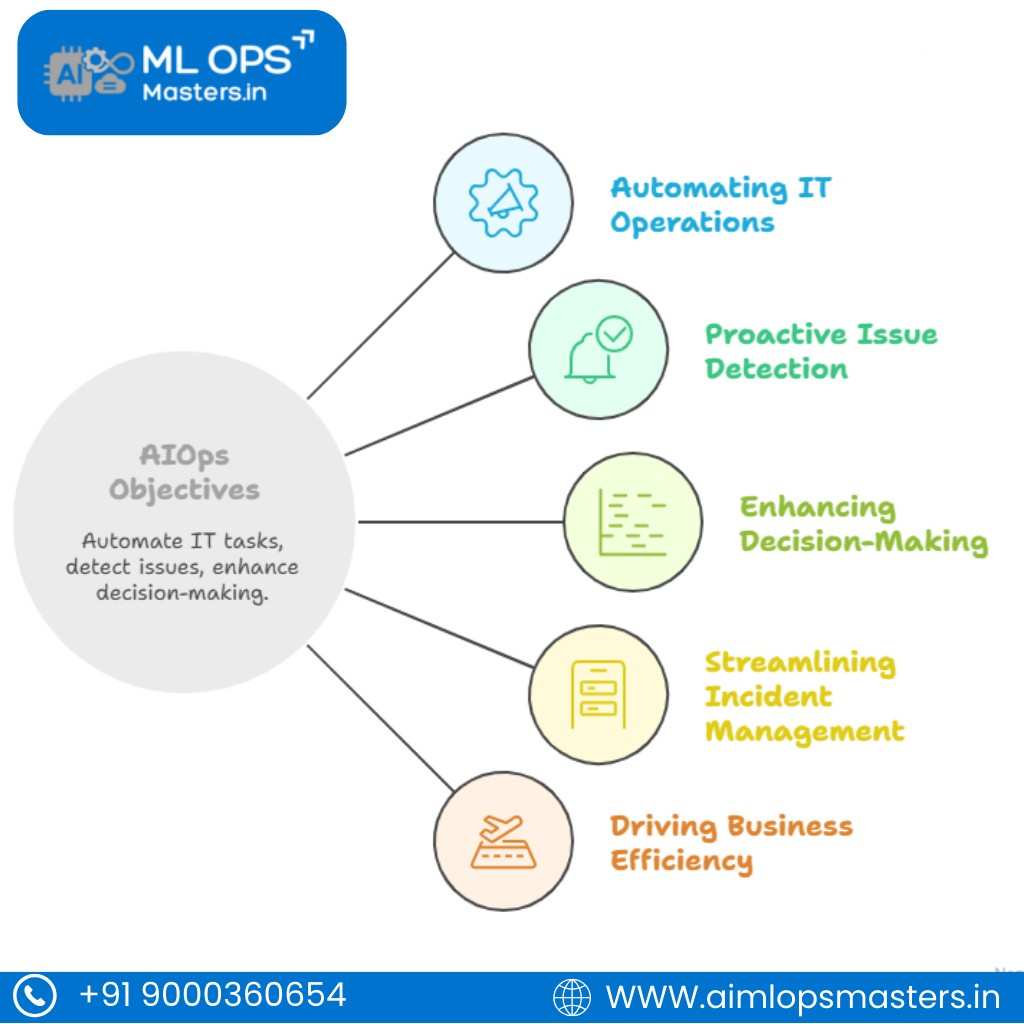
- The main objective of AIOps is to automate repetitive IT tasks. It reduces human intervention in routine monitoring and maintenance. This helps teams focus on strategic and critical activities.
- AIOps aims to identify issues before they impact users. Using machine learning and predictive analytics, it monitors anomalies. This ensures minimal downtime and uninterrupted IT services.
- AIOps provides actionable insights from large volumes of data. It uses AI-driven analytics to guide IT teams with quick decisions. This improves accuracy and efficiency in IT operations.
- The goal is to resolve incidents faster with automation and AI. AIOps reduces response times by prioritizing critical alerts effectively. This improves service reliability and customer satisfaction.
- By optimizing IT operations, AIOps reduces operational costs. It increases productivity through automation and better resource management. This helps organizations scale faster with improved performance.
Prerequisites of AIOp
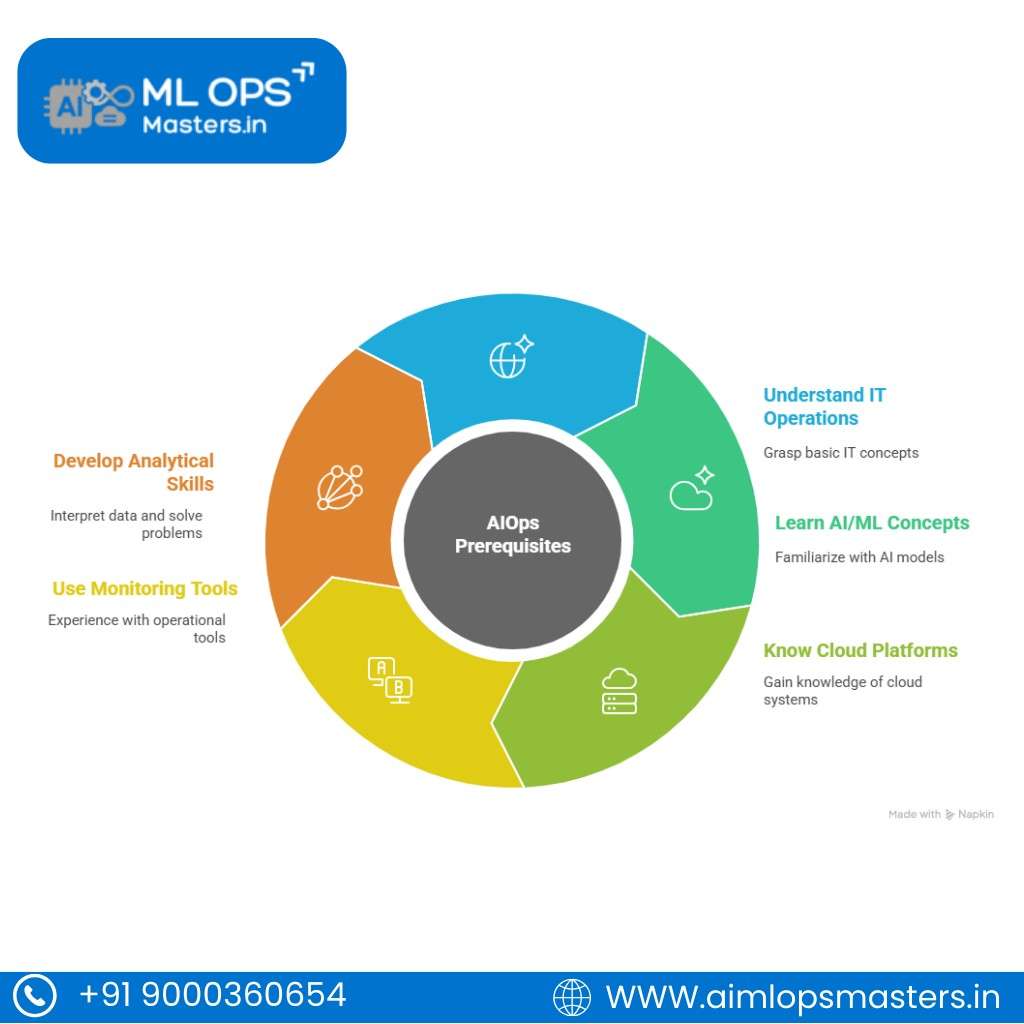
- Learners should have a basic understanding of IT operations, networks, and system infrastructure to easily grasp how AIOps integrates into existing environments.
- Familiarity with artificial intelligence, machine learning, or data science concepts will help in understanding the automation and prediction models used in AIOps.
- A working knowledge of cloud platforms, virtualization, and containerization is important since AIOps is widely applied in hybrid and multi-cloud systems.
- Prior exposure to monitoring, logging, and automation tools provides a strong foundation to explore how AIOps enhances operational efficiency.
- Strong analytical and problem-solving skills are required to interpret system data, identify patterns, and apply AIOps solutions effectively.
Who should learn AIOps course
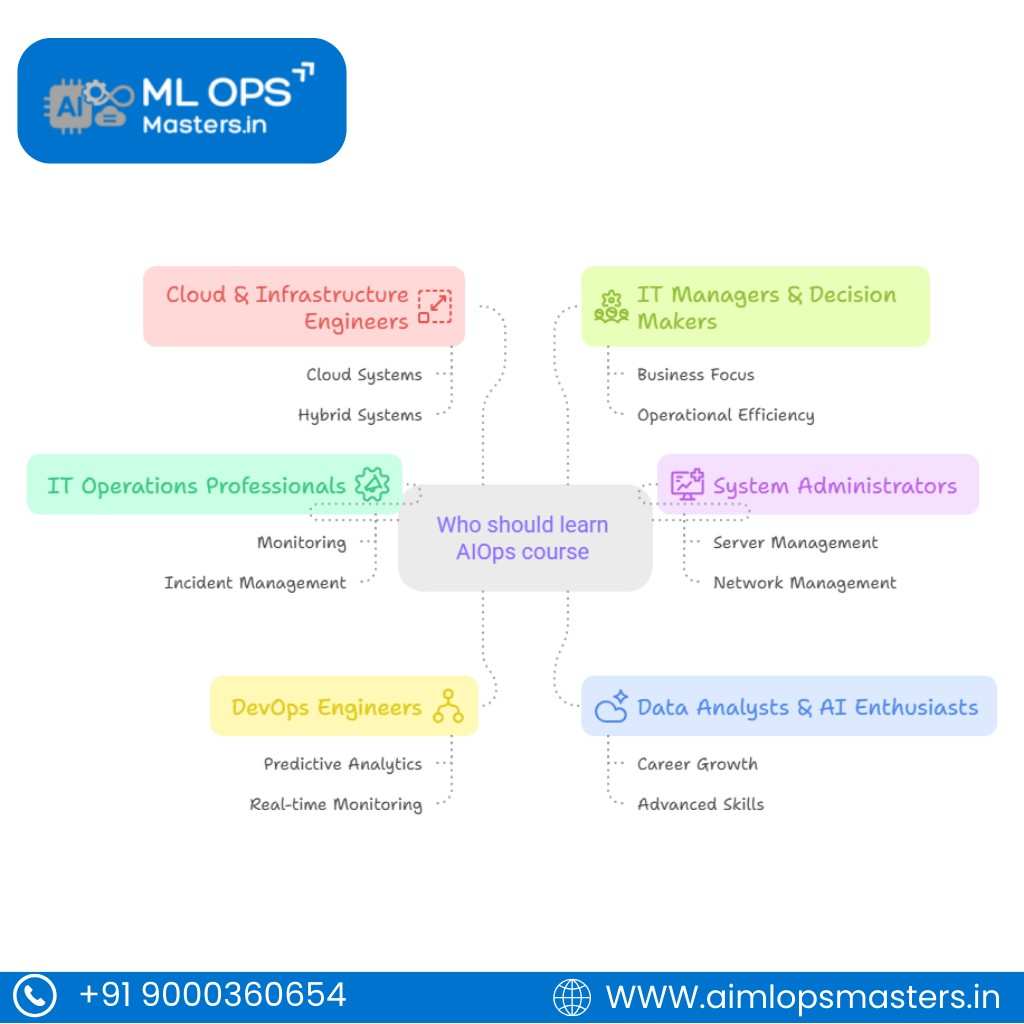
- IT Operations Professionals – Those working in monitoring, incident management, or support can use AIOps to automate repetitive tasks and improve efficiency.
- System Administrators – Admins who manage servers, networks, and cloud environments can leverage AIOps to detect issues faster and maintain system health.
- DevOps Engineers – Professionals in DevOps can integrate AIOps for smarter workflows, predictive analytics, and real-time performance monitoring.
- Data Analysts & AI Enthusiasts – Learners interested in applying AI and ML to IT operations can benefit from AIOps skills for advanced career growth.
- Cloud & Infrastructure Engineers – Those managing cloud or hybrid systems can adopt AIOps to simplify scaling, troubleshooting, and automation.
- IT Managers & Decision Makers – Leaders aiming to enhance service delivery and reduce downtime can use AIOps to drive business-focused operations.
AIOps Training in Hyderabad
Course Outline
- The course begins with an introduction to AIOps, its role in modern IT operations, and how it helps in automation and monitoring.
- Students will learn the foundations of artificial intelligence and machine learning, focusing on algorithms used in AIOps.
- The program covers big data handling, including processing logs, metrics, and events through scalable pipelines.
- You will explore event correlation techniques and noise reduction strategies to minimize false alerts and detect root causes.
- The training includes automation in IT operations, covering incident response, ticketing, and remediation workflows.
- Learners gain skills in performance monitoring and analytics for predictive maintenance and proactive system health checks.
- The course explains managing multi-cloud, on-premise, and hybrid IT environments using AIOps solutions effectively.
- Hands-on practice is provided with top AIOps platforms such as Moogsoft, Splunk, Dynatrace, and ServiceNow.
- The program concludes with interview preparation, resume building, and placement guidance for successful career outcomes.
AIOps Course In Hyderabad
Modes
Classroom Training
- Daily Recorded Videos
- One - One Project Guidence
- Practical Application
- Get support till you are placed
- Mock Interviews
- Well-Organized Syllabus
Online Training
- Flexible Learning Schedule
- Recorded Video access
- Whatsapp Group Access
- Doubt Clearing Sessions
- Daily Session Recordings
- Real-world Projects
Corporate Training
- Live Project Training
- On-site or Virtual Training Sessions
- Doubt Clearing Sessions
- Daily Class Recordings
- Team-building Activities
- Video Material Access
AIOps Training In Hyderabad
Career Opportunities
01
AIOps Engineer
Responsible for building and managing AIOps systems, focusing on automation, monitoring, and incident response across IT operations.
02
AI/ML Operations Specialist
Works on applying AI and machine learning techniques to IT operations for predictive analytics, anomaly detection, and optimization.
03
IT Operations Analyst
Monitors large-scale IT environments, analyzes logs and metrics, and supports proactive issue resolution using AIOps platforms.
04
Site Reliability Engineer (SRE)
Ensures system reliability, performance, and uptime by integrating AIOps tools into workflows for efficient problem resolution.
05
Cloud Operations Engineer
Manages hybrid and multi-cloud environments, leveraging AIOps for automation, scalability, and intelligent workload monitoring.
06
AIOps Consultant
Advises businesses on adopting AIOps strategies, selecting the right tools, and implementing automation-driven IT transformation.
AIOps Training Institute In Hyderabad
Skills Developed
Data Analysis Expertise
Ability to analyze logs, metrics, and event data to identify patterns, anomalies, and root causes in IT operations.
Machine Learning Knowledge
Skills in applying ML algorithms for predictive analytics, anomaly detection, and automated decision-making in operations.
Automation Implementation
Capability to design and deploy automated workflows that reduce manual tasks and improve IT system efficiency.
Cloud Operations Mastery
Understanding of hybrid and multi-cloud platforms with expertise in monitoring, scaling, and performance optimization.
Incident Management Skills
Proficiency in identifying, diagnosing, and resolving incidents quickly using AIOps tools and proactive strategies.
Performance Monitoring Ability
Expertise in tracking application and infrastructure health, ensuring continuous availability and reliability of systems.
AIOps Course Online Certifications
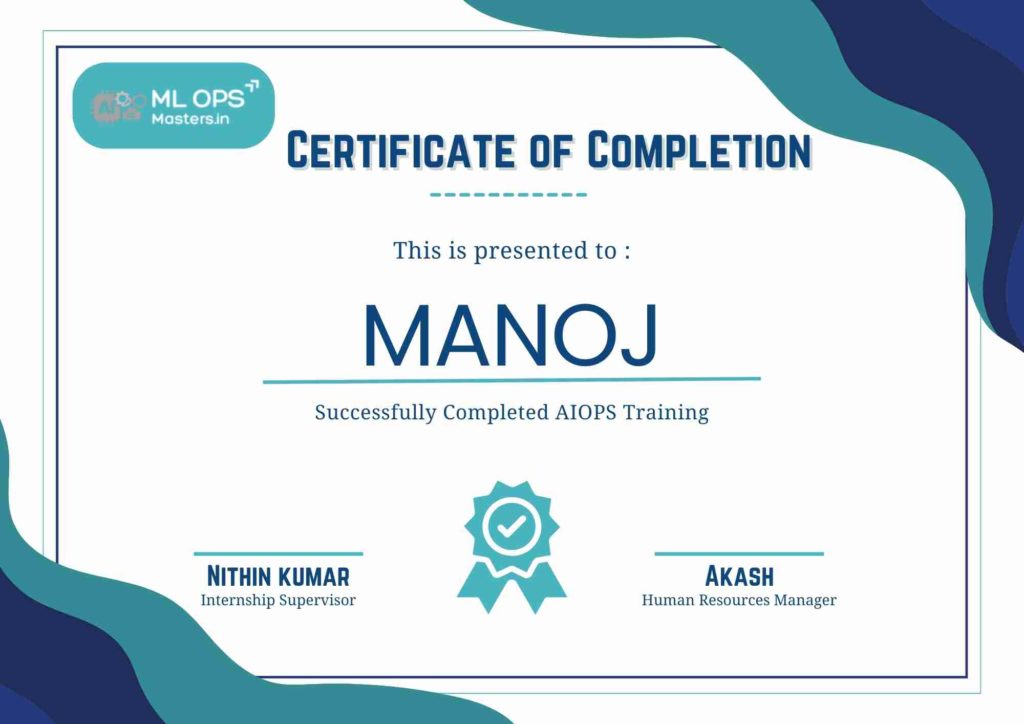
- Acts as official proof of your AIOps skills, making you stand out in interviews.
- Helps in promotions and career growth within your current organization.
- Builds trust with employers and clients by showcasing recognized expertise.
- Allows you to apply for high-demand roles in AI-driven IT operations globally.
- Increases salary potential by proving your advanced automation capabilities.





AIOps Course In Hyderabad
Benefits
Improve IT Operations Skills
Learn to optimize IT workflows using AI and automation tools. Gain expertise in anomaly detection, predictive analytics, and monitoring. These skills make you capable of managing complex IT environments efficiently.
Hands-On Project Experience
Work on real-world IT operations projects simulating enterprise environments. Practical exposure helps you apply concepts learned during training. This ensures you are job-ready with real-time problem-solving experience.
Recognized Certifications
Get guidance to complete relevant AIOps and cloud certifications. Certifications validate your skills and increase employability in top IT companies. It demonstrates your capability to implement AI-driven IT operations effectively.
Next-Level Opportunities
Training prepares you for roles like AIOps Engineer, IT Analyst, and Cloud AI Specialist. Enhances your profile for promotions or switching to high-demand AI operations roles. Focus on career-oriented learning boosts your professional growth potential.
Automate & Improve
Learn to automate repetitive IT tasks and streamline operational processes. Reduces manual errors, improves response times, and increases productivity. Organizations value these efficiency-enhancing skills highly in IT teams.
Real-Time Problem Solving
Develop the ability to detect, analyze, and resolve IT issues proactively. Learn to implement AI solutions for faster decision-making and incident resolution. This practical knowledge ensures smooth IT operations in dynamic environments.
AIOps Course
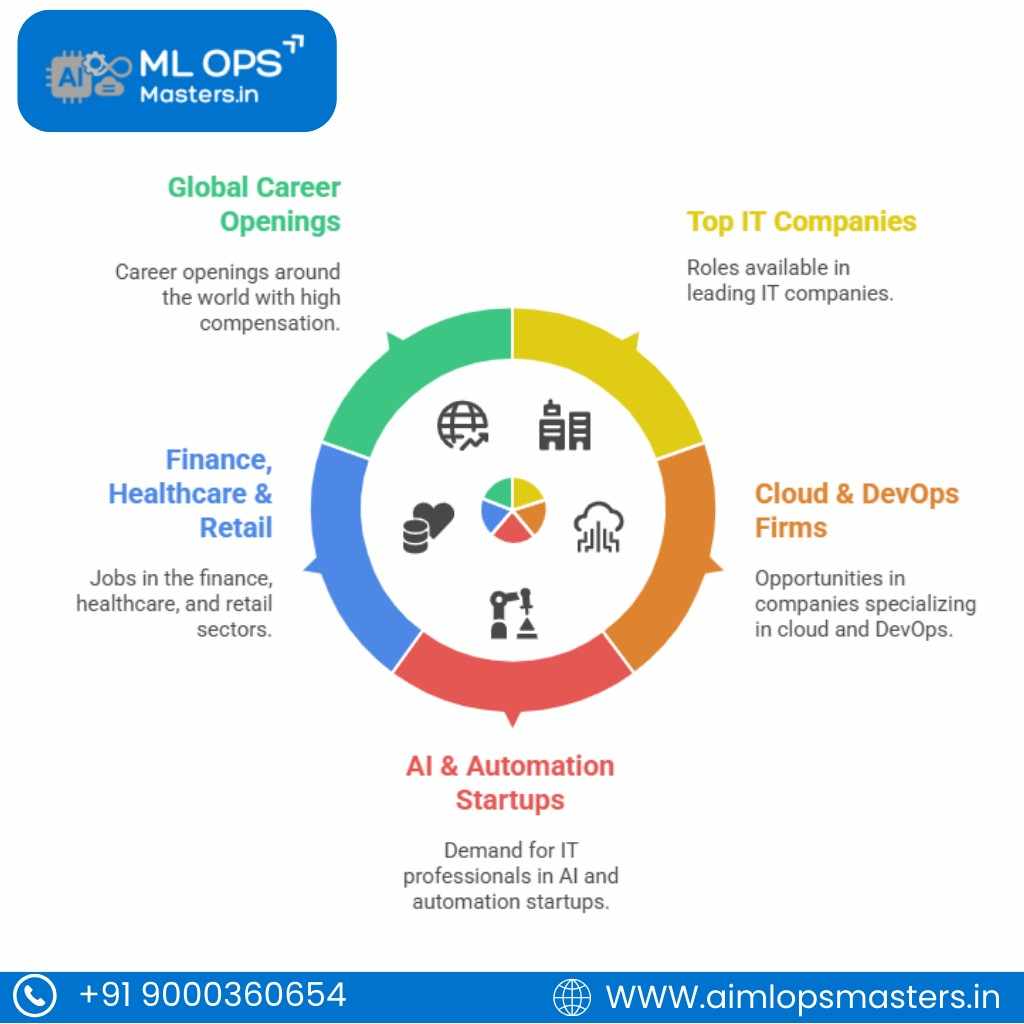
Placement Opportunities
- Roles in Top IT Companies
- Opportunities in Cloud & DevOps Firms
- Demand in AI & Automation Startups
- Jobs in Finance, Healthcare & Retail
- Global Career Openings with High Packages
AIOps Course
Market Trend
Rapid Market Growth
The AIOps market is expanding at a fast pace as enterprises adopt AI for IT operations. Global demand is projected to grow steadily over the next decade.
Cloud Adoption Driving AIOps
With businesses moving to hybrid and multi-cloud environments, AIOps is becoming essential for seamless monitoring and automation.
Focus on Automation
Enterprises are replacing manual IT processes with AIOps to achieve faster incident resolution and improved efficiency.
Increasing Demand for Skilled Professionals
Organizations are actively seeking AIOps experts who can implement and manage AI-driven operations.
Integration with DevOps
AIOps is now aligning with DevOps practices, enabling continuous monitoring, quick deployment, and reduced downtime.
Real-Time Analytics Usage
Companies are leveraging AIOps for real-time analytics to predict issues, prevent outages, and optimize IT infrastructure.
Rising Enterprise Investments
Enterprises are investing heavily in AIOps tools and training, seeing it as a long-term cost-saving solution.
Strong Career Opportunities
As adoption rises, AIOps is opening high-paying job roles like AIOps Engineer, Cloud Specialist, and Automation Architect.
Frequently Asked questions about AIOps Tranining
FAQs
What is AIOps?
AIOps means Artificial Intelligence for IT Operations, which uses AI and ML to automate and improve IT management.
Why should I learn AIOps?
AIOps is in high demand as companies adopt automation, cloud, and AI-driven IT operations.
Who can join the AIOps course?
IT professionals, DevOps engineers, cloud experts, and beginners interested in AI in IT operations.
Are there any prerequisites for AIOps?
Basic knowledge of IT operations, cloud computing, and networking is helpful but not mandatory.
How long is the AIOps course?
Most AIOps courses take 2–3 months depending on learning mode and depth.
Is AIOps difficult to learn?
No, with proper training and hands-on practice, AIOps can be learned step by step.
What skills will I gain from AIOps training?
You’ll learn automation, monitoring, data analytics, cloud integration, and AI-based problem solving.
Will I get placement assistance after the course?
Yes, most institutes provide placement support with interview preparation.
What are the career opportunities after learning AIOps?
You can work as AIOps Engineer, Cloud Automation Specialist, DevOps Analyst, or IT Operations Manager.
How much salary can an AIOps professional earn?
Entry-level salaries start from ₹5 LPA, while experienced professionals can earn ₹15–25 LPA.
Is this course available online?
Yes, AIOps courses are offered in both online and offline classroom modes.
What tools are covered in AIOps training?
Popular tools include Splunk, Moogsoft, Dynatrace, ServiceNow, and cloud monitoring platforms.
Can beginners learn AIOps?
Yes, beginners can start AIOps with basic IT knowledge and grow step by step.
Does AIOps require coding?
Minimal coding is needed. Focus is more on automation, tools, and AI-driven systems.
Will I get a certificate after course completion?
Yes, you’ll receive a recognized certification after successful completion.
How valuable is the AIOps certification?
It boosts your resume and improves career opportunities in IT automation and cloud.
Can I learn AIOps along with my job?
Yes, flexible learning options are available for working professionals.
Does AIOps replace IT jobs?
No, AIOps enhances IT roles by automating repetitive tasks and improving productivity.
Which industries use AIOps?
Banking, telecom, healthcare, e-commerce, and IT service companies are adopting AIOps.
What is the future scope of AIOps?
AIOps will become a standard for IT operations with huge career growth opportunities.
How does AIOps help in cloud computing?
It ensures better cloud monitoring, optimization, and incident management.
Can AIOps integrate with DevOps?
Yes, AIOps and DevOps together improve continuous delivery and real-time monitoring.
What learning modes are available for AIOps?
You can learn via classroom training, online live classes, or self-paced recordings.
Do I need prior AI/ML knowledge for AIOps?
Not mandatory, but understanding basics of AI/ML is useful.
Will I work on real-time projects in AIOps?
Yes, live projects and case studies are part of the training.
How does AIOps reduce downtime?
It predicts issues early, automates alerts, and resolves incidents faster.
Are AIOps jobs available in India?
Yes, demand is high in cities like Hyderabad, Bangalore, Pune, and Chennai.
What roles can freshers get after AIOps training?
Freshers can start as IT Support Analyst, Junior DevOps Engineer, or Monitoring Specialist.
How is AIOps different from traditional IT operations?
AIOps uses AI, automation, and real-time analytics, while traditional IT is manual.
Can AIOps improve my existing IT career?
Yes, it adds advanced skills to your profile and opens high-paying roles.