
MLOps Engineering Skill
MLOps (Machine Learning Operations) is a way to build, deploy, and manage machine learning models more easily. It helps teams make sure AI models work well not only during development but also after they are used in real applications.
Think of it this way: creating a machine learning model is like building a car. But before people can drive it every day, it needs testing, maintenance, and regular updates. MLOps does the same for AI models. It keeps them running smoothly and helps improve them over time.
Table of Contents
Generative AI Syllabus Introduction
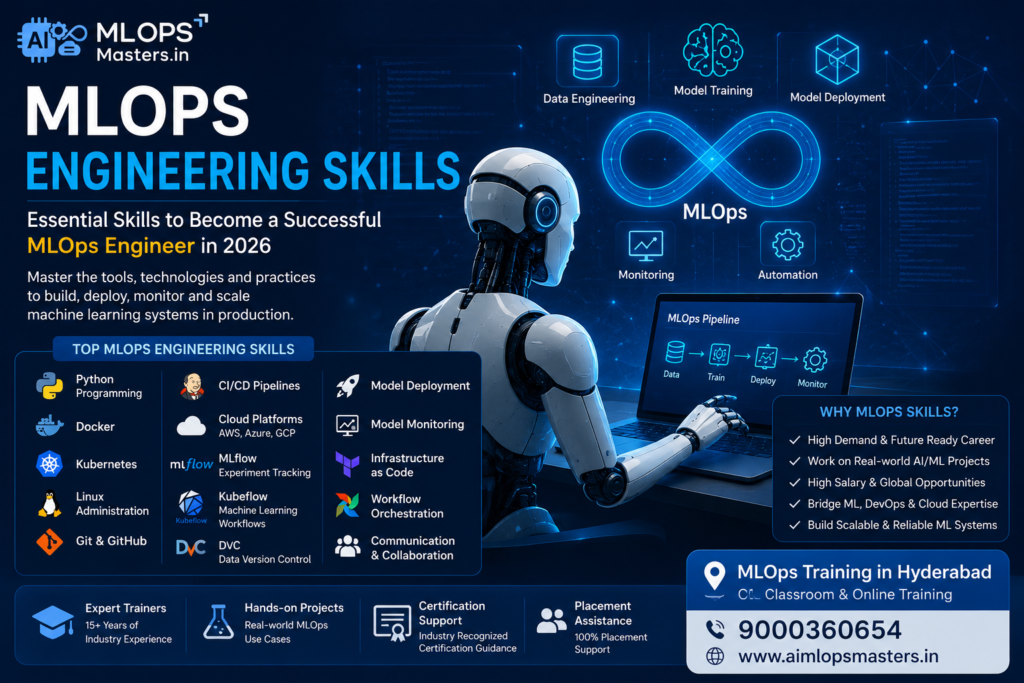
- If you want to build a successful career in AI, learning MLOps Engineering Skills is one of the smartest decisions you can make. These skills help you build, deploy, manage, and monitor machine learning models in real-world applications. Without MLOps, many AI models work well during development but fail after deployment because they are not properly automated, monitored, or maintained.
- MLOps stands for Machine Learning Operations. It is a set of methods and tools that help teams manage the complete journey of a machine learning model—from collecting data to deploying the model and keeping it up to date.
With MLOps, you can:
- Build machine learning models faster
- Deploy models with fewer mistakes
- Track changes made to models
- Monitor model performance
- Update models when new data is available
- Work better as a team
In simple words, MLOps helps turn a machine learning model into a reliable real-world application.
What is mlops engineering skills?
- An MLOps engineer is a person who helps machine learning models work properly in the real world. They don’t just build AI models—they also make sure those models are easy to deploy, run smoothly, and keep giving accurate results over time.
- For example, if an online shopping app uses AI to recommend products, the MLOps engineer makes sure those recommendations continue to work as new products and customer data are added.
- In simple words, an MLOps engineer connects machine learning with real business applications.
Why MLOps Engineering Skills Are Important in 2026
- Artificial Intelligence (AI) is growing faster than ever, and companies are using it to solve real business problems. But building an AI model is only the first step. To keep that model working well, businesses need people with MLOps engineering skill.
- These skills help companies deploy, manage, and improve machine learning models without wasting time or resources. That’s why MLOps engineers are becoming one of the most in-demand professionals in the AI industry.
- Let’s look at the main reasons why MLOps engineering skills are so valuable in 2026.
AI Is Moving into Production
- A few years ago, many companies used AI only for testing and small projects. Today, AI is part of everyday business operations.
You can see AI being used in:
- Online shopping websites
- Banking and finance
- Healthcare
- Manufacturing
- Education
- Customer support
- Digital marketing
Complete AI mlops engineering skills Syllabus Overview
- Our AI MLOps Engineering Skill syllabus is designed to help you learn everything you need to become a job-ready MLOps engineer. Whether you’re a beginner, a student, or a working professional, this roadmap covers the skills used in real AI projects.
- The syllabus starts with programming and machine learning basics, then moves to DevOps, cloud computing, MLOps tools, deployment, monitoring, and real-world projects. By the end of the learning journey, you’ll understand how to build, deploy, manage, and monitor machine learning models in production.
Now let’s unpack what actually happens inside each module.
Module 1: Introduction to Programming Fundamentals
- Programming is the first step in becoming an MLOps engineer. Before you learn machine learning, cloud computing, or deployment, you need to understand how to write code and work with different development tools.
- In this module, you’ll learn the basic programming skills that are used in almost every AI and MLOps project. These skills will help you build applications, manage code, work with data, and deploy machine learning models.
Module 2: Python Programming for Mlops
Python is the most popular programming language for Artificial Intelligence, Machine Learning, and MLOps. It is simple to learn and has many libraries that make development faster.
In this topic, you will learn:
Python basics
Variables and data types
Operators
Conditional statements
Loops
Functions
Lists, tuples, dictionaries, and sets
File handling
Exception handling
Object-Oriented Programming (OOP)
Python modules and packages
After completing this section, you’ll be able to write Python programs for machine learning and automation tasks.
Module 3: Machine Learning Fundamentals
Machine learning is a way of teaching computers to learn from data instead of writing rules for every task. The model studies the data, finds patterns, and uses those patterns to make predictions.
In this topic, you will learn:
- What is Machine Learning?
- How Machine Learning works
- Types of Machine Learning
- Machine Learning workflow
- Training and testing data
- Real-world applications
By the end of this topic, you’ll understand how machine learning models are created and used in real projects.
Module 4: Deep Learning of SQL
Most machine learning projects use data stored in databases. SQL helps you access and manage that data.
In this topic, you will learn:
- Introduction to databases
- SQL syntax
- SELECT statements
- WHERE conditions
- ORDER BY
- GROUP BY
- JOIN operations
- Aggregate functions
- Creating and updating tables
- Basic database management
By the end of this section, you’ll know how to retrieve and prepare data for machine learning models.
Module 5: Bash Scripting
Bash is used to automate simple tasks in Linux systems.
In this topic, you will learn:
- What Bash is
- Running Bash commands
- Creating Bash scripts
- Variables
- Loops
- Conditional statements
- Automating daily tasks
- Scheduling scripts
Bash scripting helps reduce manual work and improves productivity.
Module 6: Linux Commands
Most AI applications run on Linux servers. Learning Linux makes it easier to manage applications and cloud environments.
In this topic, you will learn:
- Linux file system
- Common Linux commands
- File and folder management
- User permissions
- Process management
- Package installation
- Network commands
- Disk management
These skills will help you work confidently in Linux environments.
Module 7: Git & GitHub
Git helps you track changes in your code, while GitHub allows you to store and share your projects online.
In this topic, you will learn:
- Version control basics
- Git installation
- Git commands
- Creating repositories
- Branching
- Merging
- Pull requests
- GitHub repositories
- Collaboration with teams
Git and GitHub are essential tools for every software developer and MLOps engineer.
Module 8:REST APIs
Machine learning models often communicate with other applications through APIs.
In this topic, you will learn:
- What REST APIs are
- HTTP methods
- Request and response
- JSON format
- API testing
- API integration
- Authentication basics
- API best practices
Understanding APIs will help you connect machine learning models with web and mobile applications.
Module 9: FastAPI
Flask is another lightweight Python framework used to build web applications and APIs.
In this topic, you will learn:
- Flask basics
- Creating web applications
- API development
- Routing
- Templates
- Forms
- Connecting databases
- Error handling
- Running Flask applications
Flask is easy to learn and is widely used for small and medium-sized AI applications.
Module 10: MLOps Tools and Platforms
- MLOps Engineerin Skill is not just about building machine learning models. It also involves using the right tools to manage data, train models, deploy applications, monitor performance, and automate workflows.
- In this module, you’ll learn the most popular MLOps tools and platforms used by companies around the world. These tools will help you build, deploy, and manage machine learning projects from start to finish.
- MLflow is one of the most popular MLOps tools for managing machine learning projects.
In this topic, you will learn:
MLflow basics
Experiment tracking
Model versioning
Model Registry
Model deployment
Managing the ML lifecycle
In this topic, you will learn:
Kubeflow basics
Building ML pipelines
Training models
Model deployment
Pipeline automation
Managing workflows
Kubeflow is widely used in large AI projects.
In this topic, you will learn:
Workflow automation
Task scheduling
Data pipelines
Pipeline monitoring
Workflow management
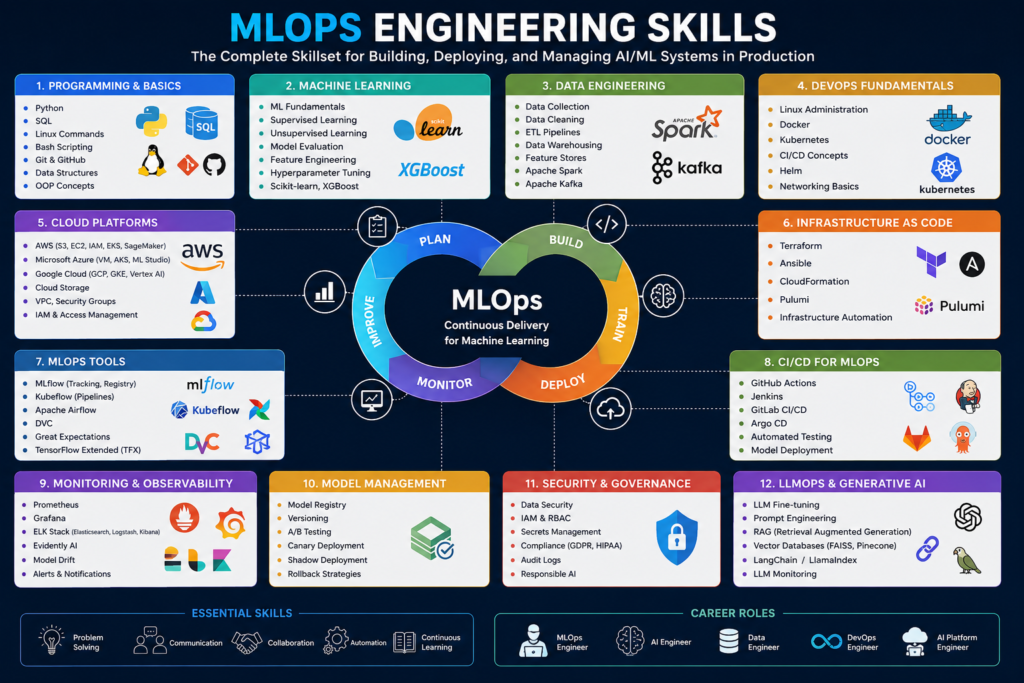
Advanced Topics Included in a Modern MLOps Engineering Syllabus
- Once you learn the basics of MLOps Engineering Skill, the next step is to explore advanced topics. These skills help you build, deploy, manage, and improve AI applications used by modern companies.
- A modern MLOps syllabus should include the following advanced topics.
1. Large Language Models (LLMs)
Learn how Large Language Models work and how they are used in real-world AI applications.
Topics covered:
Introduction to LLMs
Open-source and commercial LLMs
LLM architecture basics
Running LLMs locally
AI assistants and chatbots
Business use cases
2. Prompt Engineering
Learn how to write better prompts that help AI models produce accurate and useful responses.
Topics covered:
Prompt basics
Zero-shot prompting
One-shot prompting
Few-shot prompting
Chain of Thought prompting
Prompt testing
Prompt optimization
3. Retrieval-Augmented Generation (RAG)
Build AI applications that answer questions using your own documents and knowledge base.
Topics covered:
RAG basics
Document loading
Text chunking
Embeddings
Vector databases
Semantic search
Building AI chatbots
4. AI Agents
Learn how AI agents can complete tasks with little human input.
Topics covered:
AI Agent basics
Multi-step workflows
Tool calling
Agent planning
Memory
Business automation
5. LLMOps
Learn how to deploy, monitor, and manage Large Language Models in production.
Topics covered:
LLM deployment
Prompt versioning
Model monitoring
Cost optimization
Performance tracking
Model updates
6. Vector Databases
Store and search embeddings for AI applications.
Topics covered:
Embeddings
Vector search
Similarity search
Indexing
Data storage
Retrieval techniques
Popular tools:
ChromaDB
FAISS
Pinecone
Milvus
7. Model Monitoring
Keep machine learning models running smoothly after deployment.
Topics covered:
Model performance
Data drift
Model drift
Logging
Alerts
Error tracking
Model health checks
8. MLOps Security
Protect AI models, data, and cloud resources.
Topics covered:
Secrets management
IAM
RBAC
API security
Data protection
Secure deployment
Compliance basics
9. Cloud-Native MLOps
Learn how companies build AI applications in the cloud.
Topics covered:
AWS MLOps
Azure MLOps
Google Cloud MLOps
Kubernetes
Serverless deployment
Cloud storage
Cloud monitoring
10. CI/CD for Machine Learning
Automate testing and deployment for machine learning projects.
Topics covered:
GitHub Actions
Jenkins
GitLab CI
Azure DevOps
Automated testing
Continuous deployment
11. Infrastructure as Code (IaC)
Manage cloud infrastructure using code.
Topics covered:
Terraform
Ansible
Pulumi
Infrastructure automation
Cloud provisioning
12. End-to-End MLOps Pipelines
Build complete machine learning workflows from start to finish.
Topics covered:
Data collection
Data validation
Feature engineering
Model training
Experiment tracking
Model Registry
Deployment
Monitoring
Retraining
13. Real-Time AI Applications
Learn how to build AI systems that respond instantly.
Topics covered:
Real-time prediction
API deployment
Event-driven systems
Streaming data
Low-latency AI applications
14. Generative AI Applications
Build modern AI applications using Generative AI.
Topics covered:
AI chatbots
Content generation
Code assistants
Image generation
Document assistants
AI search systems
15. Real-World MLOps Projects
Apply your skills by building complete projects.
Projects include:
Customer Churn Prediction
Fraud Detection System
Healthcare AI Assistant
Movie Recommendation System
Image Classification
Predictive Maintenance
AI Resume Screening
LLM Chatbot
RAG-based Document Assistant
Autonomous AI Agent
What You Will Gain
After learning these advanced topics, you will be able to:
Build production-ready AI applications.
Deploy machine learning and LLM models.
Create automated ML pipelines.
Monitor and improve AI systems.
Work with cloud platforms and MLOps tools.
Build Generative AI and RAG applications.
Develop real-world projects for your portfolio.
Prepare for advanced MLOps engineering roles.
These advanced topics reflect the skills that many companies expect from modern MLOps engineers and will help you stay up to date with the latest AI and machine learning technologies
Latest Trends Covered in Generative AI Training Programs
1. Large Language Models (LLMs)
Large Language Models are changing how businesses use AI. Modern MLOps programs teach you how to deploy, manage, and monitor these models.
Topics covered:
LLM basics
Model deployment
LLM monitoring
Real-world AI applications
Performance improvement
2. LLMOps
LLMOps focuses on managing Large Language Models after deployment.
Topics covered:
Prompt management
Model versioning
Performance monitoring
Cost management
Model updates
LLMOps is becoming one of the most in-demand skills in AI.
3. Retrieval-Augmented Generation (RAG)
Many companies now build AI assistants that answer questions using company documents.
Topics covered:
RAG basics
Vector databases
Document search
Knowledge retrieval
AI chatbots
4. AI Agents
AI agents can perform tasks with very little human input.
Topics covered:
AI agent workflows
Task automation
Memory
Tool integration
Multi-step task execution
5. Cloud-Native MLOps
Most companies deploy AI applications on cloud platforms.
Topics covered:
AWS
Microsoft Azure
Google Cloud
Cloud deployment
Cloud monitoring
6. Kubernetes for AI
Kubernetes helps manage AI applications at scale.
Topics covered:
Container management
Scaling applications
Load balancing
High availability
Deployment management
7. Automated ML Pipelines
Automation saves time and reduces manual work.
Topics covered:
MLflow
Kubeflow
Apache Airflow
Pipeline automation
Workflow management
8. Model Monitoring
Machine learning models need regular monitoring after deployment.
Topics covered:
Model performance
Data drift
Model drift
Logging
Alerts
Retraining
9. CI/CD for Machine Learning
Modern AI teams automate testing and deployment.
Topics covered:
GitHub Actions
Jenkins
GitLab CI
Azure DevOps
Automated deployment
10. Infrastructure as Code (IaC)
Cloud infrastructure can now be managed using code.
Topics covered:
Terraform
Ansible
Pulumi
Infrastructure automation
11. MLOps Security
Keeping AI systems secure is more important than ever.
Topics covered:
IAM
RBAC
Secrets management
API security
AI governance
Compliance
12. Generative AI Applications
Generative AI is being used across many industries.
Topics covered:
AI chatbots
Content generation
Code assistants
AI search
Business automation
13. Real-Time AI Systems
Many businesses need AI models that can make predictions instantly.
Topics covered:
Real-time predictions
Live data processing
Event-driven applications
Fast API deployment
14. Edge AI
Some AI applications run directly on devices instead of cloud servers.
Topics covered:
Edge deployment
Device optimization
Offline AI
Smart devices
IoT integration
15. Hands-on Industry Projects
Modern training programs focus on practical learning through real-world projects.
Projects include:
Customer Churn Prediction
Fraud Detection
Healthcare AI
Image Classification
Recommendation System
LLM Chatbot
RAG-based AI Assistant
Real-Time Prediction API
Autonomous AI Agent
Why These Trends Matter
Learning the latest MLOps trends helps you:
Stay updated with new AI technologies.
Build real-world AI applications.
Work with industry-standard tools.
Improve your problem-solving skills.
Increase your job opportunities.
Prepare for future AI careers.
Key Takeaway
A modern MLOps training program is much more than learning machine learning. It covers LLMs, LLMOps, RAG, AI Agents, cloud platforms, Kubernetes, CI/CD, MLflow, Kubeflow, model monitoring, security, and real-world projects. By learning these latest trends, you’ll be ready to build, deploy, and manage AI applications that meet today’s industry needs.
Conclusion
- Mastering MLOps engineering skills prepares you to build, deploy, monitor, and scale machine learning solutions in real-world production environments. By combining programming, cloud computing, DevOps practices, and machine learning knowledge, you can become a valuable contributor to modern AI teams.
- Whether you are a software developer, DevOps engineer, cloud engineer, or data professional, investing in MLOps skills today can open doors to exciting career opportunities in the rapidly evolving world of artificial intelligence.
Frequently Asked Questions
1. What are MLOps engineering skills?
MLOps engineering skills are the technical and practical skills required to build, deploy, monitor, and manage machine learning models. These include Python, Docker, Kubernetes, cloud platforms, Git, CI/CD, MLflow, and machine learning fundamentals.
2. What skills are required to become an MLOps engineer?
To become an MLOps engineer, learn Python, Linux, Git, SQL, machine learning, Docker, Kubernetes, cloud platforms (AWS, Azure, or Google Cloud), CI/CD, and tools like MLflow or Kubeflow. Communication and problem-solving skills are also valuable.
3. Is Python necessary for MLOps?
Yes. Python is the primary programming language for MLOps and is widely used for machine learning, automation, APIs, and workflow management.
4. Do I need to learn DevOps before MLOps?
You don’t need to master DevOps, but understanding Linux, Git, Docker, Kubernetes, and CI/CD will make learning MLOps much easier.
5. Which cloud platform is best for MLOps?
AWS, Microsoft Azure, and Google Cloud are all excellent choices. Start with one platform and build a strong foundation before exploring the others.
6. Is MLOps a good career in 2026?
Yes. MLOps continues to be one of the fastest-growing AI careers as organizations increasingly deploy machine learning models in production.
7. What tools should every MLOps engineer learn?
Every MLOps engineer should learn Python, Git, Docker, Kubernetes, MLflow, Kubeflow, Apache Airflow, Terraform, Prometheus, and Grafana.
8. What is the difference between MLOps and DevOps?
DevOps focuses on software development and deployment, while MLOps specializes in deploying, monitoring, and managing machine learning models throughout their lifecycle.
9. How long does it take to learn MLOps?
With Python and machine learning knowledge, you can learn MLOps fundamentals in 4–6 months. Beginners typically need around 8–12 months to become job-ready.
10. Is MLOps difficult to learn?
MLOps can be challenging because it combines machine learning, DevOps, and cloud computing. With consistent learning and hands-on projects, it becomes much easier.
11. Do MLOps engineers need coding skills?
Yes. Python is essential, and basic knowledge of Bash scripting and SQL is also helpful for automation and data-related tasks.
12. Does MLOps require machine learning knowledge?
Yes. You should understand core machine learning concepts such as regression, classification, feature engineering, and model evaluation before learning MLOps.
13. What projects should I build to learn MLOps?
Start with projects like Customer Churn Prediction, Spam Detection, or Movie Recommendation. Later, build advanced projects such as Fraud Detection, Image Classification, or LLM Deployment.
14. Which industries hire MLOps engineers?
MLOps engineers are hired across industries including healthcare, finance, retail, manufacturing, insurance, education, telecommunications, logistics, and cybersecurity.
15. What is the salary of an MLOps engineer?
MLOps salaries depend on experience, location, and technical skills. Professionals with cloud and Kubernetes expertise generally earn higher salaries.
16. Can a DevOps engineer become an MLOps engineer?
Yes. DevOps engineers already have strong automation and cloud skills, making it easier to transition by learning machine learning concepts and MLOps tools.
17. Can a data scientist become an MLOps engineer?
Yes. Data scientists already understand machine learning and mainly need to learn deployment, cloud platforms, Docker, Kubernetes, and CI/CD.
18. Is MLOps a good career for freshers?
Yes. Freshers with strong Python, machine learning, cloud, and MLOps skills can find opportunities in startups, IT companies, and AI organizations.
19. What is the best way to learn MLOps?
Learn Python, Linux, Git, SQL, and machine learning first. Then practice Docker, Kubernetes, cloud platforms, MLflow, CI/CD, and build real-world projects.
20. Which certifications are useful for MLOps engineers?
Popular certifications include AWS Certified Machine Learning, Microsoft Azure AI Engineer Associate, Google Professional Machine Learning Engineer, Docker Certified Associate, Kubernetes certifications, and TensorFlow Developer Certificate.
21. What are the most important MLOps engineering skills for beginners?
Beginners should focus on Python, Linux, Git, SQL, machine learning basics, Docker, and cloud fundamentals. These provide a solid foundation for advanced MLOps concepts.
22. What is the difference between an MLOps engineer and an ML engineer?
An ML engineer builds and trains machine learning models, while an MLOps engineer deploys, monitors, automates, and maintains those models in production.
23. Which companies hire MLOps engineers?
MLOps engineers are hired by AI startups, IT service companies, healthcare organizations, banks, e-commerce companies, cloud providers, and manufacturing firms.
24. Can I learn MLOps without cloud computing?
Yes, you can learn the basics without cloud computing. However, cloud platform knowledge is essential for most real-world MLOps roles.
25. How can I improve my MLOps engineering skills?
Practice consistently by building real-world projects, using cloud platforms, contributing to GitHub, and learning new MLOps tools. Hands-on experience is the fastest way to improve.

Generative AI Trainer
GenAI Masters AI Experts | 60+ Articles Published on Generative AI, Prompt Engineering, LLMs & AI Careers
We are a team of Generative AI professionals dedicated to helping students and working professionals build successful careers in Artificial Intelligence. Through comprehensive guides, practical training resources, industry insights, certification support, and the latest AI trends, we simplify complex concepts such as Large Language Models (LLMs), Prompt Engineering, Agentic AI, RAG, and AI Automation to provide job-ready skills and real-world knowledge for career growth.